As a public transport provider, SWK Verkehrs-AG makes a significant contribution to improving the city of Kaiserslautern’s carbon footprint. To achieve the ambitious climate targets, SWK, as a mobility provider, also has a role to play. This requires the continuous renewal of the bus fleet, the use of the latest technology and a systematic transition to renewable energy sources. The fact that this approach is a recipe for success for the future has been officially confirmed by the certification body.
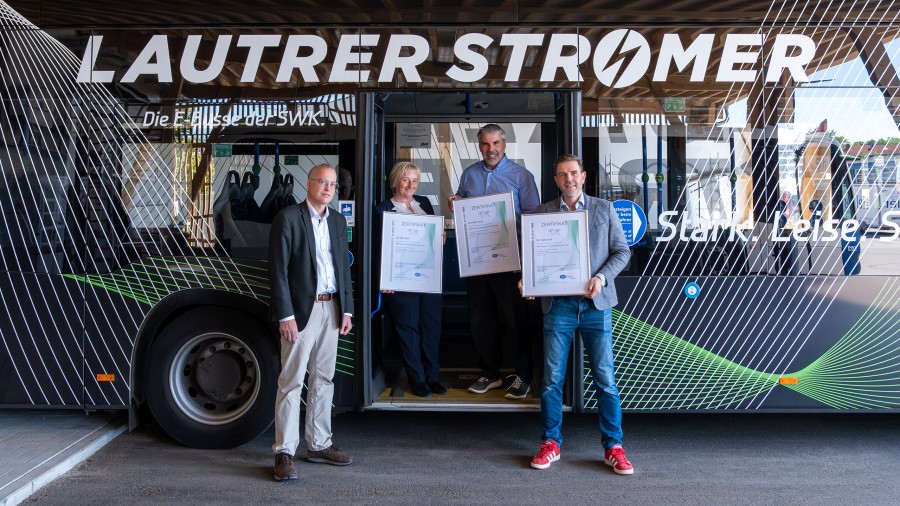
On 15 June 2026, Boris Habermann of DEKRA Certification GmbH presented the new certificates to Dr Arvid Blume, CEO of SWK Stadtwerke Kaiserslautern Verkehrs-AG.
SWK Stadtwerke Kaiserslautern Verkehrs-AG operates an integrated management system comprising quality management (ISO 9001), environmental management (ISO 14001) and energy management (ISO 50001). The certified management system is audited annually by the certification body against all three standards. In addition, a comprehensive audit is carried out every three years as part of the certification process. Since 2016, the recertification of all three pillars has now been successfully completed for the fourth time.
“We see our integrated management system as a driving force for continuous improvement and further development,” explained Boris Flesch at the ceremony. “Our customers feel the benefits of these improvements directly, as we transport them to their destinations comfortably, quietly and safely in modern, low-emission buses.”
“For us, this certification not only provides legal certainty but is also a unique selling point compared to other service providers,” added Dr Arvid Blume, “as this accreditation is very important for the city of Kaiserslautern, given that it has entrusted us with the operation of its public transport system. In Kaiserslautern, we can only achieve the legally mandated climate targets if we, as a public transport operator, drastically reduce our own emissions and successfully carry out the necessary transformation.”
Electric buses and new fuels as drivers of the energy transition
This important transformation was launched in 2025 with the ‘Lautrer Stromer’. Ten electric buses are currently in regular service. Six more vehicles will be added this summer. The new electric buses are more comfortable to ride in, make less noise and produce no emissions. Compared to a diesel bus, they require only a third of the energy, which is, of course, sourced from green electricity supplied by SWK Versorgungs-AG or generated locally using our own solar panels.
To reduce emissions, diesel buses have also been converted to run on renewable energy sources. Since December 2025, the newer diesel buses in the fleet have been running on HVO 100, a renewable diesel substitute. This means that harmful greenhouse gas emissions from the combustion of fossil fuels can already be significantly reduced. This has laid the foundations for the transformation of public transport and marked an important milestone in SWK GmbH’s climate vision.
In terms of the emissions to be reduced, the greatest potential for improvement lies in the fuel consumption of the 68-vehicle bus fleet, which currently already includes 10 electric buses. According to SWK GmbH’s climate vision, the electrification of the fleet, which began in 2025, is set to be fully completed by 2036.
The fuel used is being systematically optimised: by switching to ‘Fuelsave diesel’ (a high-quality fuel that burns efficiently and cleanly), approximately 2.5 per cent of fuel consumption – and thus around 90 tonnes of CO₂ emissions – has been saved annually since 2016. The plant-based diesel substitute ‘HVO 100’, introduced in 2025, produces around 90 per cent fewer CO₂ emissions compared with diesel. In 2026 alone, around 1,600 tonnes of CO₂ emissions will be avoided by switching all newer diesel buses in the fleet to this fuel.
For many years now, SWK Verkehrs-AG has been investing heavily and strategically in modern, low-emission and high-performance technology. In doing so, the public transport company is making an important contribution to environmental and climate protection and is playing a key role in helping the city of Kaiserslautern achieve its climate targets.