
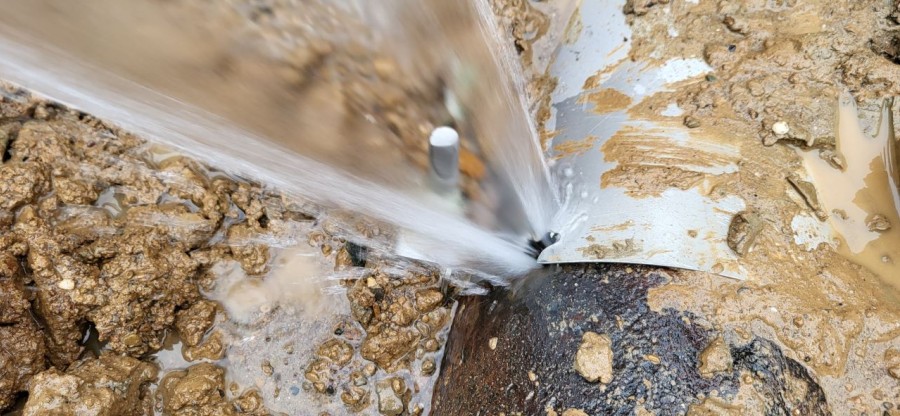
SmartWine aims to solve long-standing infrastructure problems in the water sector. Small leaks in underground water pipes, in particular, often go undetected and lead to significant, ongoing losses. This further exacerbates the problem of water scarcity in many regions of the world. “As well as wasting valuable resources, water suppliers also have to maintain higher pressure, which leads to rising energy costs when the pumps remain in continuous operation,” says Dr Amin E. Bakhshipour, who conducts research in the field of urban water management at the RPTU and heads the project.
Whilst traditional night-time measurements can indicate a possible leak, experts must then meticulously inspect the pipework using acoustic methods. This works relatively well with traditional cast-iron pipes. Modern polyethylene plastic pipes, however, make it considerably more difficult to locate leaks due to their sound-absorbing properties. Meanwhile, water is constantly being lost – at considerable cost to the economy and the environment.
Data-driven leak detection
“Our research will revolutionise this process by combining expertise in modern data analytics with knowledge from engineering to detect and locate leaks in real time,” explains the civil engineer and data scientist. “Instead of waiting for visible damage to occur, we harness the potential of data-driven anomaly detection, physics-based models and graph neural networks – an AI-supported technique – to proactively detect even the slightest deviations in pressure and flow before any loss occurs.”
Raw data from sensors at key points in the network provides immediate warning signals to the maintenance team, enabling field staff to take targeted and rapid action. This saves large quantities of water whilst significantly reducing operating costs, as fewer staff hours are required for the laborious search for hidden leaks. Furthermore, timely action can prevent costly pipe bursts, minimise health risks from potential contamination and reduce unnecessary energy costs associated with operating at excessive pressure.
Local authorities set to benefit from SmartWine
Through the partnership with Stadtwerke Kaiserslautern, the research team can test the methods developed in a real-world supply network, ensuring that research findings are quickly put into practice. “With water losses below seven per cent, we are in a good position,” explains Jürgen Storck of SWK Kaiserslautern, who, as Head of Asset Management, is also responsible for the strategy relating to networks and facilities. “However, the trend has been rising in recent years. To meet future challenges posed by ageing networks whilst minimising losses, we are keen to trial these innovative preventive solutions. The SmartWine research project has our full support.”
On the RPTU side, scientists from the departments of Civil Engineering and Mathematics are working closely together on this interdisciplinary project. Alongside Dr Amin E. Bakhshipour, Professor Ali Haghighi and Professor Ulrich Dittmer from the Urban Water Management group, as well as Professor Sven Krumke from the Optimisation research group, are also involved.
Press contact:
Julia Reichelt University
Communications RPTU
E: presse(at)rptu.de
Dorothea Schröder Press
Office SWK Stadtwerke Kaiserslautern
E: presse(at)swk-kl.de
About the RPTU
The Rhineland-Palatinate University of Technology Kaiserslautern-Landau (RPTU), with around 17,000 students and over 1,600 researchers, is the state’s technical university. Its research activities and range of degree programmes encompass engineering, natural and environmental sciences, educational and social sciences, mathematics and computer science, psychology, and teacher training for all types of schools. Through research and teaching that are often interdisciplinary in nature, the RPTU finds solutions to societal challenges such as climate change and the energy transition. It also lays the scientific foundations for driving forward both digitalisation and the digital transformation. As a centre for world-class international research, a breeding ground for academic talent and a partner for innovation and knowledge transfer, the RPTU engages in constant dialogue with the worlds of politics, business, society and the research community. Anyone who studies, conducts research or works at the RPTU is part of a diverse university community and is helping to shape the future. Find out more at rptu.de