In total, the federal government is providing around 3.3 million euros in funding for the transition, thereby covering 60 per cent of the additional costs involved in switching to a zero-emission powertrain of the future.
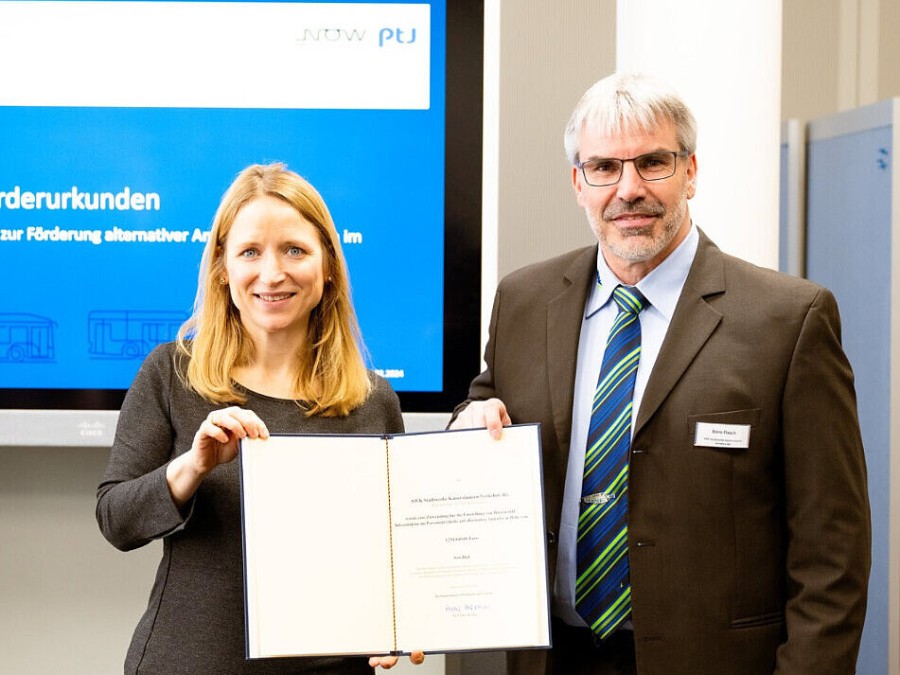
The official handover of the grant certificate took place last Thursday in Berlin. The certificate was presented by Daniela Kluckert, Parliamentary State Secretary at the Federal Ministry of Digital and Transport.
“We are delighted that it has now worked out in Kaiserslautern too. We can now actively tackle the mobility transition here as well and have planning certainty,” says Boris Flesch, Head of Division at SWK Verkehrs-AG. Rainer Nauerz, Chief Technical Officer at SWK Stadtwerke Kaiserslautern, adds: “The switch to electric mobility in public transport will make a significant contribution to measurably reducing CO₂ emissions, as well as air pollution and noise levels, right on our doorstep. This will noticeably improve the quality of life for all residents. That is why political representatives at local, state and federal level have also supported our project. Leading the way are Matthias Mieves, Member of the Bundestag, and Andreas Rahm, Member of the State Parliament, who have actively campaigned for funding in Kaiserslautern. Our collective perseverance has ultimately led to success. I would like to thank everyone for that.”
Beate Kimmel, Lord Mayor of Kaiserslautern, welcomes the federal government’s decision: “For the city, this positive funding decision is a major step towards a sustainable Kaiserslautern. In particular, the positive environmental impact resulting from the gradual conversion of the bus fleet sends a clear signal in favour of greater climate protection. In this way, our transport services are making a valuable contribution to our home town.”
SWK Stadtwerke Kaiserslautern Verkehrs-AG, a municipal transport company owned by the City of Kaiserslautern, operates 16 bus routes. Around 3.2 million vehicle-kilometres of service are covered each year. The fleet currently consists of 67 buses. A large number of these vehicles are already equipped with a hybrid module. Thanks to the electric assistance, these require significantly less fuel than conventional diesel vehicles.
In addition to procuring environmentally friendly electric buses, the transport company is also developing the necessary charging infrastructure. SWK naturally charges its electric fleet using green electricity. The company plans to integrate further electric buses into its existing fleet in future. The aim is for SWK to have at least 60 per cent of its bus fleet electrified by 2030.
The funding programme run by the Federal Ministry of Digital and Transport (BMDV) supports the procurement of buses with environmentally friendly, alternative drive systems, such as those based on battery and fuel cell technology.